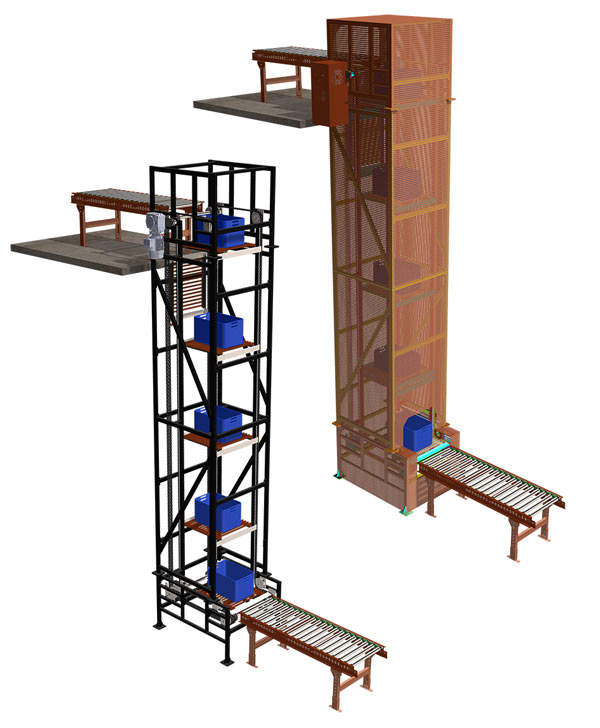
A Continuous Vertical Lifting (CVL) system is an automated material-handling solution designed to move goods continuously between different floor levels or elevations. It uses platforms, carriers, or conveyors that operate in a continuous or cyclic manner, reducing the need for manual lifting and conventional forklifts.
Key Features
- Continuous material flow: Enables efficient movement of materials between multiple levels.
- High throughput: Suitable for warehouses, manufacturing plants, distribution centers, and logistics facilities.
- Space efficient: Requires relatively little floor space compared with ramps or conventional lifting arrangements.
- Automation: Can be integrated with conveyors, warehouse management systems, sensors, and automated storage systems.
- Safety: Enclosed and controlled lifting mechanisms reduce manual handling and associated risks.
- Flexibility: Can handle cartons, pallets, totes, containers, and other unit loads depending on system design.
Working Principle
Materials are loaded onto a lifting platform or carrier at one level. The system continuously transports the load vertically to the required level, where it is discharged onto an outbound conveyor or workstation. Empty carriers return for the next load, creating a continuous material flow.
Applications
- Multi-level warehouses
- Manufacturing and assembly lines
- Distribution and fulfillment centers
- Automotive and industrial facilities
- Food and beverage plants
- Automated storage and retrieval systems
Benefits
A continuous vertical lifting system can increase productivity, reduce labor requirements, improve workplace safety, optimize vertical space, and provide consistent material flow. It is particularly valuable where large volumes of goods must be transferred between multiple levels quickly and reliably.