Hydraulic lifting stackers and electric stackers are compact material handling solutions designed to transport and stack palleted loads vertically in warehouses, manufacturing floors, and retail stockrooms where full-sized forklifts are impractical.
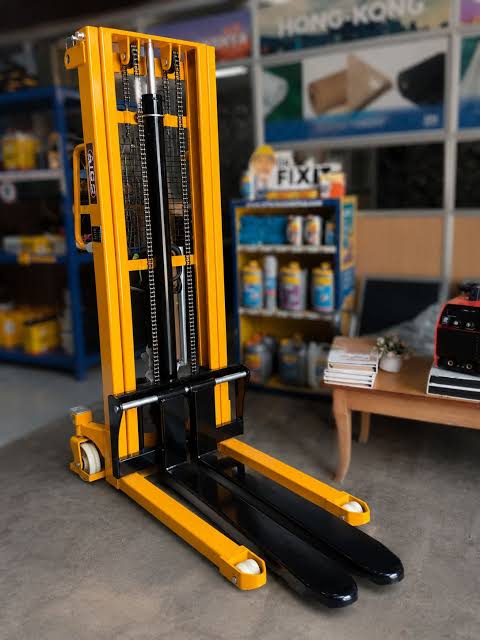
1. Hydraulic Lifting Stacker (Manual / Semi-Electric)
A manual hydraulic stacker relies entirely on physical effort via a hand pump or foot pedal to operate a hydraulic piston, elevating the forks. Horizontal movement requires manual pushing and pulling. Semi-electric variants pair a powered hydraulic lift pump with manual push-pull transport.
-
Operation: Manual pumping for lift, manual pushing/pulling for motion.
-
Lift Capacity: Typically 500 kg to 2,000 kg.
-
Lift Height: Standard range of 1.6 m to 3.0 m.
-
Best Used For: Low-frequency loading/unloading, small workshops, light duty, and short travel distances.
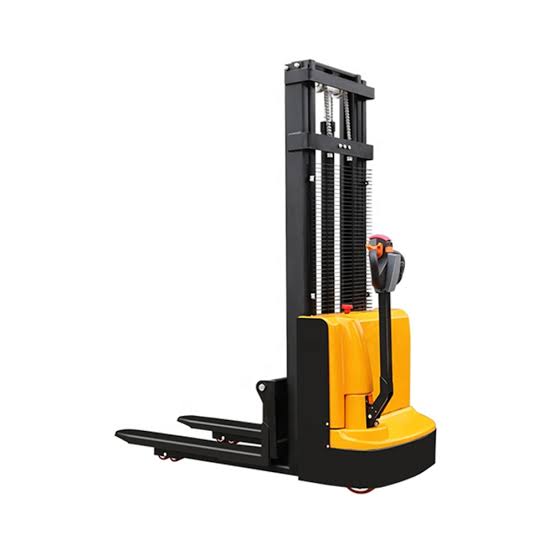
2. Electric Stacker (Fully Electric)
An electric stacker (or power stacker) utilizes electric motors powered by rechargeable batteries (lead-acid or lithium-ion) for both vertical lifting and horizontal drive motion. Operators control drive and lift speed using a till-head tiller handle (walkie stacker) or stand on a ride-on platform.
-
Operation: Motor-driven travel and motor-driven hydraulic lift.
-
Lift Capacity: Typically 1,000 kg to 2,500 kg+.
-
Lift Height: Standard range of 2.0 m up to 6.0 m (with multi-stage masts).
-
Best Used For: High-volume distribution centers, medium-to-high racking systems, long travel distances, and multi-shift operations.