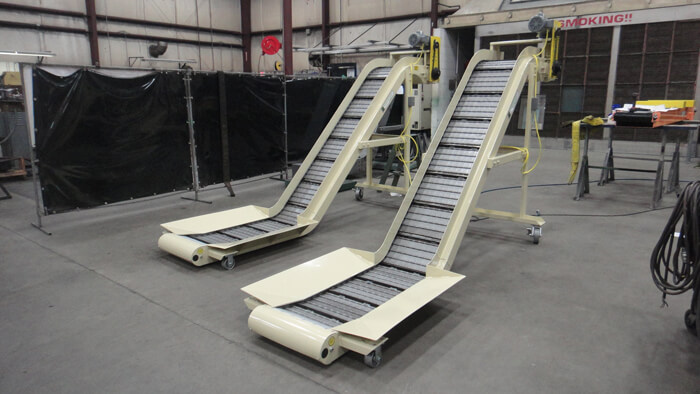
A hinge-belt (chain-type) conveyor uses interconnected steel plates/hinges that form a continuous belt. Chips are carried on the belt and discharged into a bin or trolley.
- Best suited for: heavy, bulky, broken, bushy, and stringy chips.
- Typical materials: steel, aluminium, brass and other machining scrap.
- Advantages: robust construction, high load capacity, suitable for inclined conveying, and adaptable with cleats, perforations and coolant filtration.
A scraper/drag conveyor uses flights or paddles attached to a chain to drag chips along the bottom of a trough toward the discharge point.
- Best suited for: fine, short, broken chips and swarf.
- Typical materials: cast iron, steel, aluminium, brass and similar machining debris.
- Advantages: good collection of small particles, compact design, and can be combined with coolant tanks and filtration.
Comparison
| Parameter |
Hinge-Belt |
Scraper |
| Operating principle |
Carries chips on hinged plates |
Drags chips with flights |
| Heavy chips |
Excellent |
Good |
| Fine chips/fines |
Moderate |
Excellent |
| Stringy/bushy chips |
Excellent |
Poor |
| Large scrap |
Excellent |
Limited |
| Coolant separation |
Optional perforated belt/filtration |
Optional filtration |
| Typical use |
CNC turning, milling, machining centres |
Fine-chip machining, grinding/machining |
| Relative robustness |
Very high |
High |
Material-Handling Benefits
Both systems provide continuous automated material flow, taking chips directly from the machine to a collection bin, hopper, or recycling system. Integration with coolant tanks and filtration can also allow coolant recovery and reduce waste.